At GreenBuzz, we believe that sustainability transitions require more than innovation alone. They require critical thinking, transparency, and the willingness to ask better questions about the systems and technologies shaping our future.
Artificial Intelligence is increasingly positioned as a key driver of sustainability transformation. Across industries, AI is being presented as a solution for efficiency, optimization, reporting, climate modelling, and operational performance. At the same time, the environmental and social impacts of AI infrastructure, energy demand, resource extraction, and digital inequality are becoming harder to ignore.
This tension makes one thing clear: the conversation around AI and sustainability needs more nuance.
In this thought leadership piece, Fiona Leibundgut, GreenBuzz Ambassador for AI × Sustainability, explores some of the most common pitfalls in how AI and sustainability are discussed today, from “magic bullet” narratives to the lack of transparency around data centres, rebound effects, and human costs hidden within AI supply chains.
Rather than rejecting AI or blindly celebrating it, the article invites us to approach the topic with greater precision, accountability, and systems thinking. A perspective we believe is essential if AI is to contribute meaningfully to a more sustainable future.
Full Article by Fiona Leibundgut
AI and Sustainability Communication: Avoiding the Most Common Pitfalls
AI and sustainability are, perhaps, the two most pervasive buzzwords of the modern era. Both are umbrella terms that encompass a vast array of technologies, policies, and philosophies. The result is a growing vocabulary of vague claims: “AI sustainability”, “Green AI”, “climate-positive technology”, to name just a few. When we attempt to merge AI and sustainability into a single conversation, it is no surprise that we fall into predictable linguistic and conceptual pitfalls and omit critical context in the use of AI technology.
To have a meaningful conversation about the role of AI in a sustainable future, we urgently need to address these common pitfalls in how we talk about them. Without precise communication, we risk misleading people, enabling greenwashing, and creating a false sense of progress, while the true related risks and impacts of AI remain unaddressed.
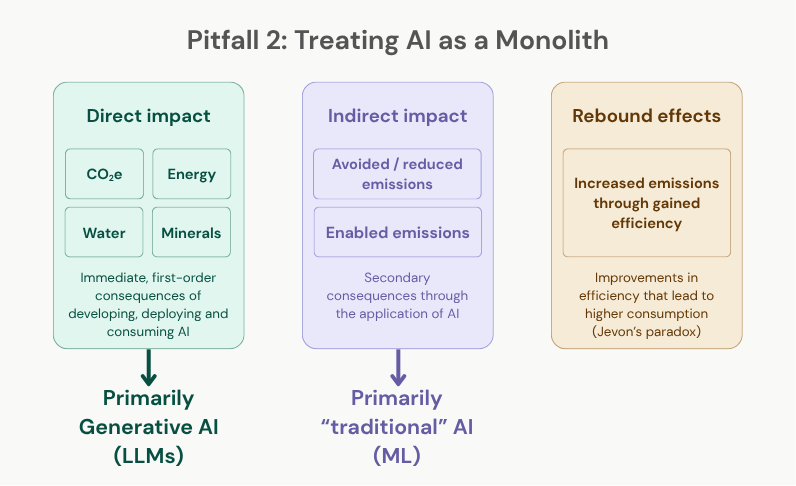
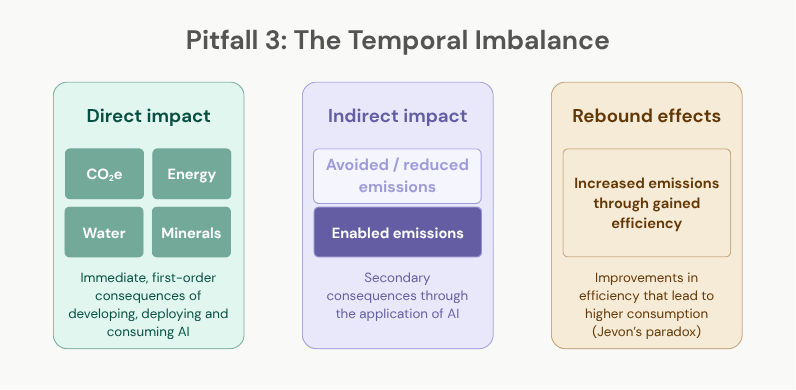
The impact of AI can broadly be categorized into three areas:
Direct impact: Immediate, first-order consequences of developing, deploying and consuming AI. This is notably the impact of building and running data centers that host AI technology
Indirect impact: Secondary consequences through the application of AI. This is all about how we decide to deploy AI solutions: are we using the technology to solve for climate, social, biodiversity or human rights issues (avoided / reduced emissions)? Or are we using AI solutions to accelerate exploitative and extractive industries?
Rebound effects: Improvements in efficiency that lead to higher consumption, also known as Jevon’s paradox. By making a tool more efficient, its relative emissions go down (e.g. CO2e per prompt), but overall emissions increase
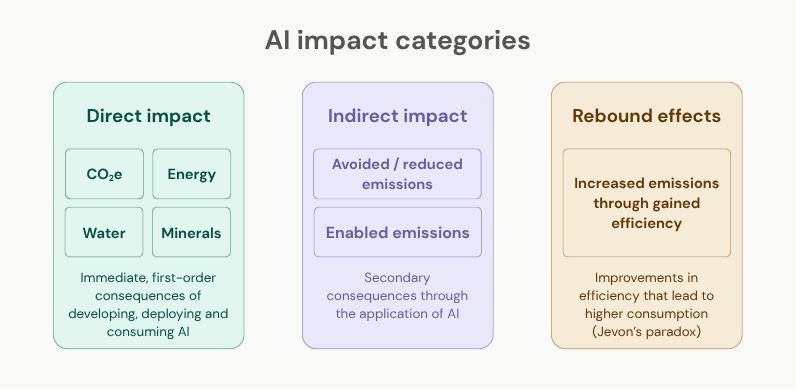
Understanding this range of impact is what makes clear communication so difficult, and so important. When the subject spans such complex, interrelated issues, it is easy to oversimplify, cherry-pick, or lose sight of critical context. This is where the pitfalls come into play.
There are four common pitfalls observed in the public discourse on AI and sustainability:
- Pitfall 1: The “Magic Bullet” Fallacy
- Pitfall 2: Treating AI as a Monolith
- Pitfall 3: The Temporal Imbalance
- Pitfall 4: Ignoring the Human Cost
Each pitfall reflects a different way in which the conversation around AI and sustainability loses precision, and with it, accountability. Recognizing them is the first step toward a more honest discourse.
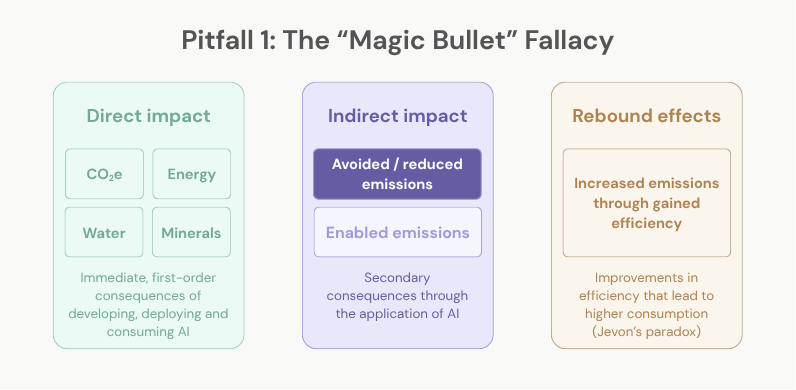
Pitfall 1: The “Magic Bullet” Fallacy
The most common narrative is that AI will simply “fix” the climate crisis. This perspective treats AI as a benevolent force that optimizes our way out of disaster. However, this view conveniently ignores two critical factors: the growing AI data center footprint and enabled emissions. It lays the full focus on avoided or reduced emissions. This is a popular narrative, and an optimistic one. It is one that works well for technology companies developing AI solutions to encourage their customers to focus on the merits and potential of their technology, rather than the direct emissions.
A recent report by the Green Web Foundation: State of the Fossil Free Internet 2026 – The Dirty Data Center Edition found that Google Cloud, Amazon Web Services and Microsoft Azure have very low transparency scores in providing transparency about fossil fuel use in their data centers. Only Google Cloud scored 22.56% transparency, while Amazon Web Services and Microsoft Azure scored 0% each.
The “Magic Bullet” narrative also conveniently omits enabled emissions, well researched by the Enabled Emissions Campaign: “The results are stark: conservative estimates show that AI, the ”internet of things”, and cloud computing are enabling the fossil fuel industry to boost yields by up to 15%.”
Likely due to the complexity of Jevon’s paradox, the rebound effects of AI are also often neglected though not insignificant. In OpenAI’s first release, their generative model was only available through an API – something that requires some technical skill to set up. When they released ChatGPT with a web interface, the use of their models exploded. Through gains in efficiency when accessing the tools, the consumption was significantly higher.
Pitfall 2: Treating AI as a Monolith
We often speak of AI as if it were a single tool. Phrases like ‘AI will reduce carbon emissions’ or ‘AI is an environmental threat’ commit this mistake, making sweeping claims that could apply to any kind of AI. In reality, AI is a broad spectrum of technologies, ranging from traditional machine learning (ML) and predictive analytics to generative AI and autonomous agents.
These are not created equal. A lightweight ML model used to predict crop yields has a radically different environmental footprint and utility than a massive Large Language Model (LLM) that requires thousands of GPUs to run. When we group them all together, we obscure the nuance of where the real costs lie and where the actual potential for sustainability exists.
This misdirection was researched and findings published by Ketan Joshi in his report The AI Climate Hoax: Behind the Curtain of How Big Tech Greenwashes Impacts: Reviewing 154 claims of climate benefits for AI, the study finds: “150 (97%) relate to ”traditional” AI, such as predictive models, computer vision (…) or a narrow application of generative systems. Only 4 (3%) related in any way to recognisable forms of consumer generative AI systems, such as interactive chatbots trained on large public datasets.”
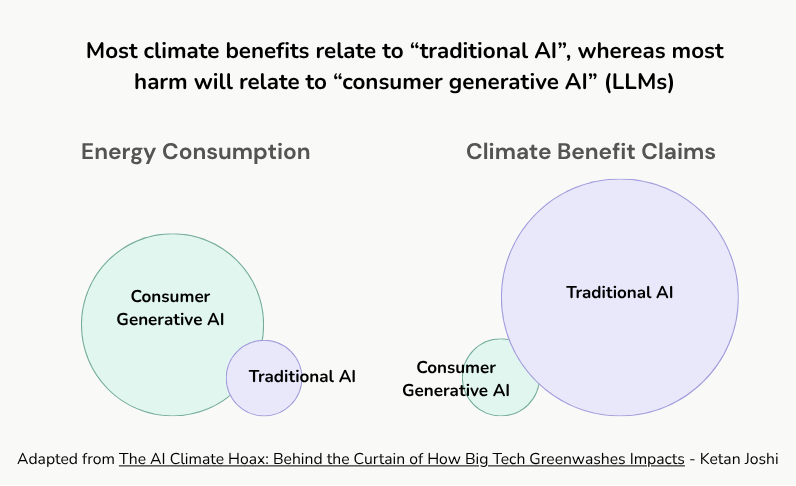
In other words, the technologies being credited with sustainability benefits are largely not the AI systems dominating today’s public conversation. Yet both are routinely referred to simply as ‘AI’, creating a false equivalence that inflates the perceived sustainability potential of modern generative systems.
Pitfall 3: The Temporal Imbalance
In current discourse, there is a disconnect between how we discuss impacts. We acknowledge the immediate, tangible footprints: the rapid acceleration of data center construction and the current energy surge. Yet, when it comes to the benefits of AI for the planet, the conversation almost exclusively shifts to the future.
This temporal disconnect is also addressed in the Green Web Foundation’s State of the Fossil-Free Internet 2026 report. Google, Amazon, and Microsoft have each announced net-zero targets stretching to 2030 and 2040, yet their actual emissions are rising sharply today. US data centre carbon intensity is already 48% higher than the national average, and US greenhouse gas emissions rose by 2.4% in 2025, with data centers cited as a leading cause. The future benefits, meanwhile, remain speculative: the report explicitly calls the industry’s claims that AI will “solve” climate change a false narrative. Environmental costs are being locked in now through infrastructure built today, while the promised payoff stays firmly in the future. This imbalance is visible across all four categories of direct impact:
CO2e: Emissions are accumulating today. Tech firms are seeing their actual emissions rise sharply, even as their net-zero targets stretch years into the future.
Energy: The infrastructure locking in energy demand is being built right now. Efficiency improvements in AI models are promised for the future, but the power contracts and gas plants are signed and constructed today.
Water: Hyperscale data centres consume water at the scale of entire towns, primarily for cooling, and these withdrawals are happening immediately. Water-saving technologies are frequently cited as a future roadmap item rather than a current requirement.
Minerals: The mining of materials such as lithium, copper, and rare earth elements required for AI hardware carries immediate environmental and social costs. Circular economy approaches remain marginal compared to the scale of current demand.
What makes this pitfall particularly dangerous is that the infrastructure being built today will shape emissions for decades. By the time the promised payoff arrives, the environmental costs will already be irreversible.
Pitfall 4: Ignoring the Human Cost
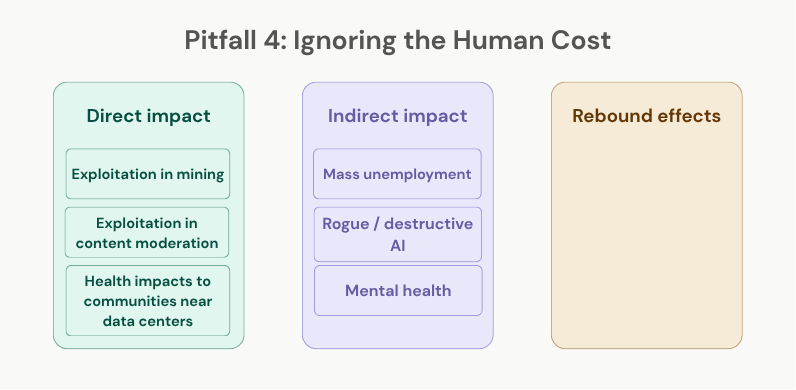
When we discuss the social impact of AI, we tend to drift toward science fiction: the fear of mass unemployment or the spector of a rogue AI. While these are valid areas of study, they distract us from the systemic social impacts happening right now.
The sustainability of AI is not just about climate; it is also about people. This includes the grueling conditions of mining the raw materials required for hardware, the strain on local communities living near data centers, and the psychological toll on workers performing the invisible labour of content moderation.
The Green Web Foundation’s 2026 report demonstrates how people living near data centers face toxic emissions linked to higher rates of asthma, heart disease, and cancer, alongside drying water supplies and rising electricity bills. These harms are not evenly distributed: communities in hotter regions and the Global South bear a disproportionate share of the burden.
The human cost does not stop at the fence line of the data centre. Behind the polished experience of AI tools sits an invisible workforce whose conditions rarely enter the conversation. Content moderators, typically hired through subcontractors in lower-income countries, are routinely exposed to extreme violence and other deeply disturbing content, often processing hundreds of cases per hour, with little pay and no meaningful mental health support. According to research by Equidem, published by the Institute for Human Rights and Business in 2025, the subcontracting model creates deliberate distance between tech giants and the exploitation in their supply chains. When such conditions become standard practice, the exploitation is no longer accidental but institutional.
By focusing on future dystopias, we ignore the people already bearing the cost of AI today.
How to avoid these pitfalls
We must stop using AI and sustainability as buzzwords and start using them as precise tools. Recognizing these pitfalls is the first step; avoiding them is the next.
- When a tech company promises AI will solve a sustainability challenge, demand specifics: which technology, at what energy cost, verified by whom. Companies are unlikely to volunteer this information, which is precisely why demanding transparency matters.
- When you encounter a sustainability claim tied to “AI”, identify the actual technology behind it. Is it a large generative model, a traditional machine learning algorithm, or an autonomous agent? Each carries a vastly different footprint. Name the technology and force more honest accounting.
- Distinguish clearly between what is happening now and what is promised for the future. Present-tense language should describe present-tense evidence. Future benefits should be labelled as such.
- Broaden your definition of sustainability beyond carbon and energy. Ask who bears the cost: communities near data centres, workers in supply chains, content moderators. Sustainability without people is incomplete.
The stakes of getting this right are higher than they might appear. When AI and sustainability remain vague terms, the full range of impacts, direct, indirect, and rebound, becomes impossible to measure, debate, or govern. The four pitfalls described in this article are not abstract communication errors; they have real consequences for the communities bearing the environmental and human costs of AI right now. Precise language is not a stylistic preference. It is the foundation on which honest discourse, meaningful policy, and genuine progress must be built.
Final Thoughts from GreenBuzz
At GreenBuzz, we see one of the biggest challenges in sustainability today as the growing gap between technological optimism and systemic reality.
AI undoubtedly holds transformative potential. But potential alone is not impact. The way AI is designed, powered, governed, and deployed will determine whether it becomes a tool for genuine sustainability progress or simply another layer of extraction and complexity.
What Fiona’s article highlights particularly well is the importance of moving beyond simplified narratives. Sustainability conversations cannot stop at efficiency gains or future promises. They must also include difficult questions around energy systems, transparency, labour conditions, resource use, accountability, and long-term societal consequences.
As AI becomes more embedded into business, policy, and sustainability strategies, we believe organizations will need not only technical capabilities, but also stronger sustainability literacy, ethical reflection, and interdisciplinary dialogue.
The future of AI and sustainability should not be shaped only by what is technologically possible, but also by what is socially responsible, environmentally credible, and collectively beneficial.
This is exactly the kind of conversation we want to continue fostering through the GreenBuzz community.
This article was originally written and published by Fiona Leibundgut on LinkedIn. You can read the original version here.